A Consumption Pattern That Cannot Hold
The average Australian buys 56 new pieces of clothing every year. Of those, 33 are thrown away — roughly 227,000 tonnes of textiles — and around 20 are made from non-biodegradable synthetic fibres, according to the Australian Fashion Council’s Clothing Data Report . This is not a distant environmental abstraction. It is a household-level pattern repeated across the country, and it is compounding into one of Australia’s fastest-growing waste streams.
The national textile waste picture is equally stark: Australia generates an estimated 800,000 tonnes of textile waste annually, equivalent to approximately 36 kilograms per person . Seamless, the national clothing stewardship scheme, reports that more than 880 million garments, totalling about 220,000 tonnes, ended up in Australian landfill in a single year . The clothing system, as Seamless CEO Ainsley Simpson puts it, “is just not designed to handle the volume and the speed of clothing moving through our markets” .
Overproduction Is the Hidden Engine
Waste is not only a post-consumer problem. It is manufactured upstream. Offshore manufacturers impose minimum order requirements that force Australian brands to order up to 30% more garments than they actually need, Simpson notes . Unsold clothing volumes are increasing by approximately 17% year on year, while less than 5% of textiles are recycled in Australia . The system produces surplus by design, and that surplus becomes landfill by default.
How Made-to-Order Interrupts the Cycle
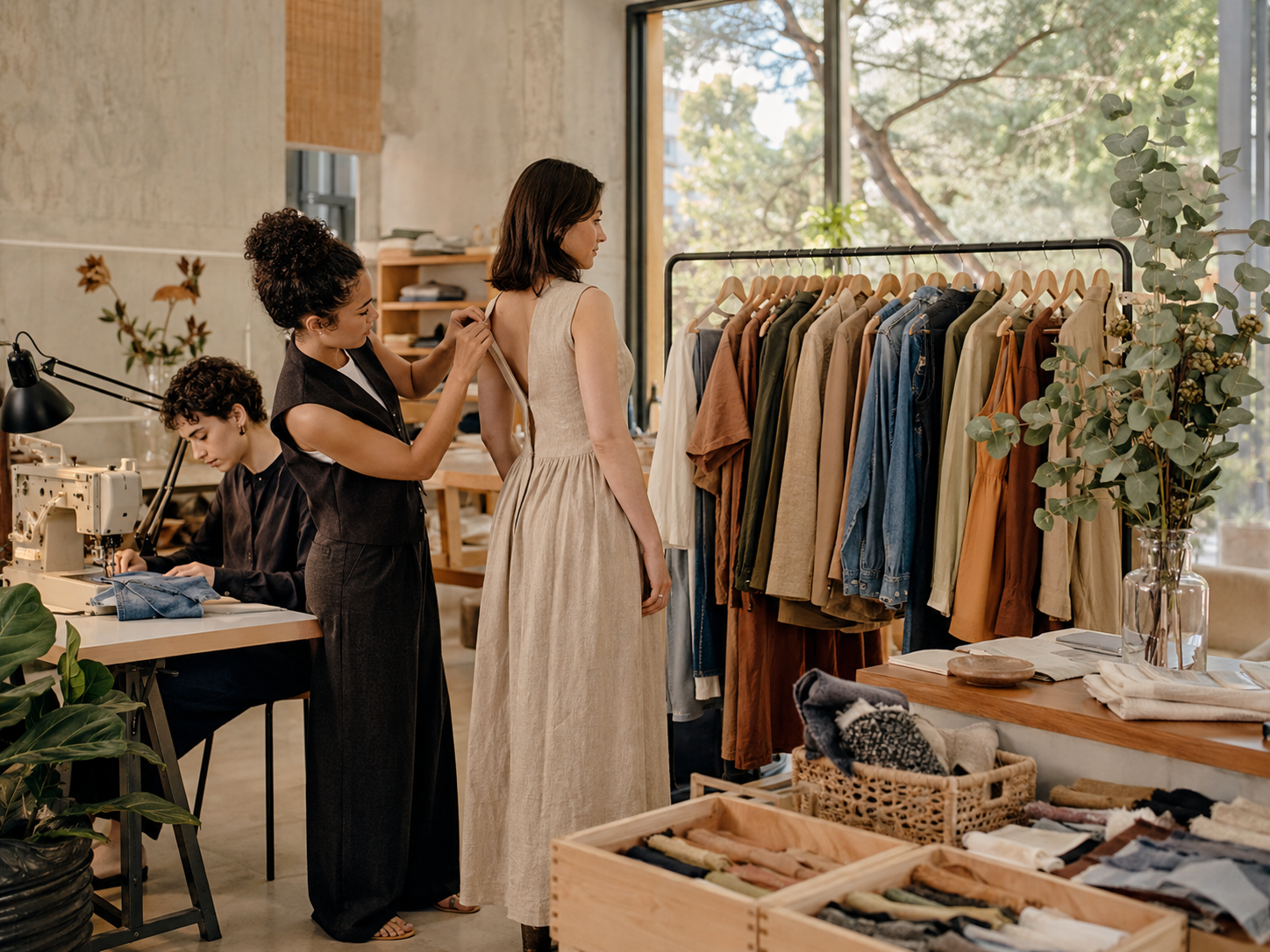
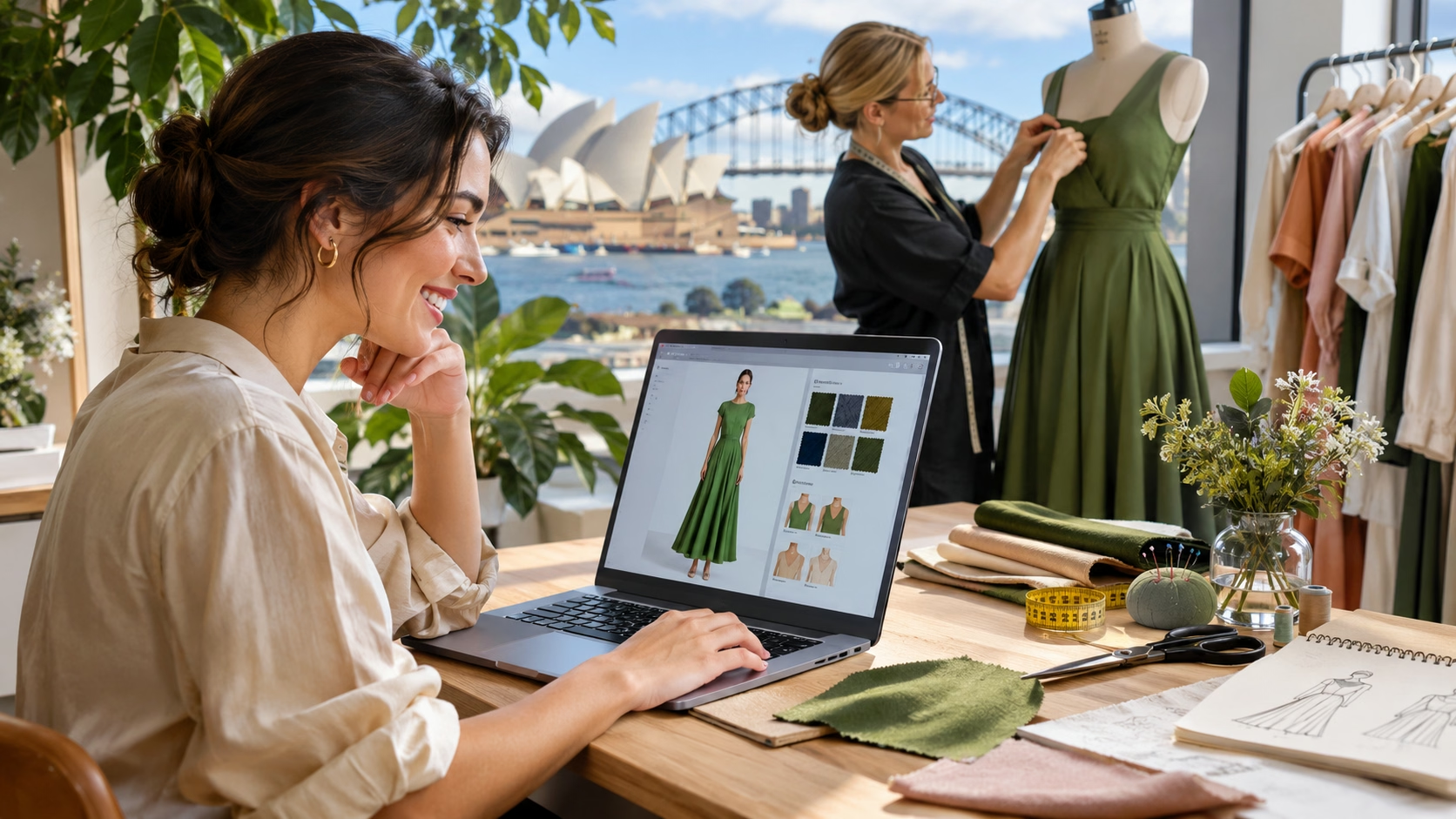
Made-to-order fashion attacks the waste problem at its source. When a garment is produced only after a customer orders it, there is no speculative inventory to discard. There is no end-of-season markdown pile. There is no warehouse full of sizes that nobody wanted. The model decouples production volume from forecasting error, which is precisely where the overproduction embedded in mass fashion originates.
The environmental arithmetic is measurable. Citizen Wolf, a Sydney-based made-to-measure label, reports that its carbon footprint is half that of fast fashion, a direct consequence of producing only what is demanded and manufacturing locally . Localised, small-batch production also reduces the emissions associated with long-distance shipping, a factor the global fashion industry’s overproduction-and-export model rarely accounts for .
Circularity Requires More Than a Production Method
Made-to-order is not a complete circular economy in itself. Garments still reach the end of their useful life. This is why the Seamless Scheme, Australia’s first circular clothing product stewardship initiative, matters. It proposes a 4-cent-per-garment levy to fund programs that incentivise durable design, recyclability, and landfill diversion . Made-to-order brands that already design for longevity and local repairability are natural participants in this framework.
The behavioural dimension is equally important. Made-to-order slows the transaction. It asks the shopper to wait, to specify, and to commit. That pause is not a bug; it is a counterweight to the impulse mechanics of ultra-fast fashion. When 51% of Gen Z online purchases are returned, according to the latest AusPost e-commerce reporting, the case for demand-led production becomes both environmental and commercial .
A Waste Strategy That Starts at the Design Stage
Australia’s clothing waste problem will not be solved by recycling alone. It requires a production model that does not generate surplus in the first place. Made-to-order fashion offers that logic at scale: fewer garments made, fewer garments discarded, and a closer alignment between what is produced and what is genuinely worn.