A VFX Studio Designed for the Generative Era
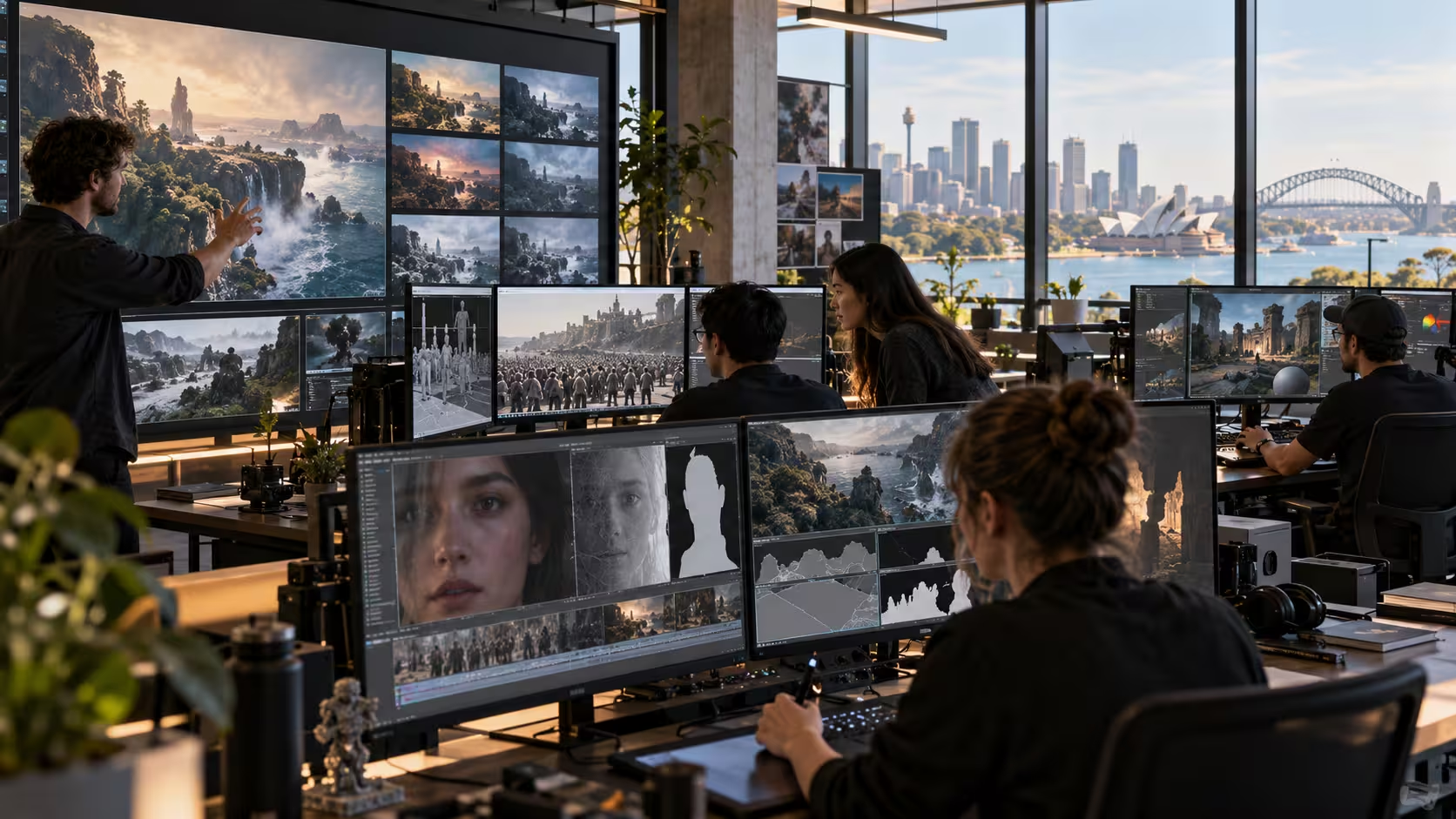
Alussein VFX did not emerge as a traditional boutique. Launched in 2025 and based in Sydney and Adelaide, the studio has built its operating model around a deliberate fusion: traditional filmmaking expertise plus machine learning, artificial intelligence, advanced automation and adaptive pipelines. In January 2026, it appointed Jennie Zeiher, former president of Rising Sun Pictures, as CEO—a move that brought decades of high-end VFX leadership into a studio explicitly designed for an AI-shaped production landscape.
Zeiher’s background is instructive. At Rising Sun Pictures, she drove early adoption of machine learning in 2018 through a partnership with the Australian Institute of Machine Learning, supported by the South Australian government. That experience positions Alussein not as an AI startup experimenting with generative imagery, but as a craft-led studio integrating AI into production-grade pipelines.
What “Adaptive Pipelines” Actually Mean for VFX Artists
In practical terms, adaptive pipelines allow a VFX studio to shift compute and human attention dynamically across a shot. Generative AI can produce variation sets for environment design, de-ageing references or crowd simulation passes, while machine learning accelerates repetitive tasks such as rotoscoping, tracking and compositing prep. The artist’s role moves upstream: directing the system, curating outputs and protecting narrative intent.
This model directly addresses a structural problem in Australian VFX: the country has world-class talent but often loses high-end work to larger offshore studios because of cost and turnaround pressure. Alussein’s bet is that AI-augmented efficiency can keep more complex sequences onshore without degrading quality. Zeiher framed the moment as a generational shift, arguing the studio is “challenging every assumption about how creative work gets made” and building a future where “intelligence, imagination, and engineering converge”.
The Adelaide–Sydney Corridor and Sovereign VFX Capability
The studio’s dual-city footprint is not incidental. Adelaide has become a recognised VFX and machine-learning hub, partly through the AIML partnership and South Australian government support. Sydney remains the commercial centre of Australian screen production. By linking the two, Alussein can tap into both creative decision-makers and deep technical research capacity.
For Australian filmmakers, the rise of studios like Alussein matters because generative VFX is often discussed as a cost-cutting tool. The more consequential story is capability. If Australian VFX houses can integrate generative systems into supervised, artist-led pipelines, they can bid for work that previously went overseas. If they cannot, the risk is that generative tools become a race to the bottom on price. Alussein’s model is a test case for whether Australian VFX can compete on intelligence rather than just cost.