The Geography of Fire Has Changed
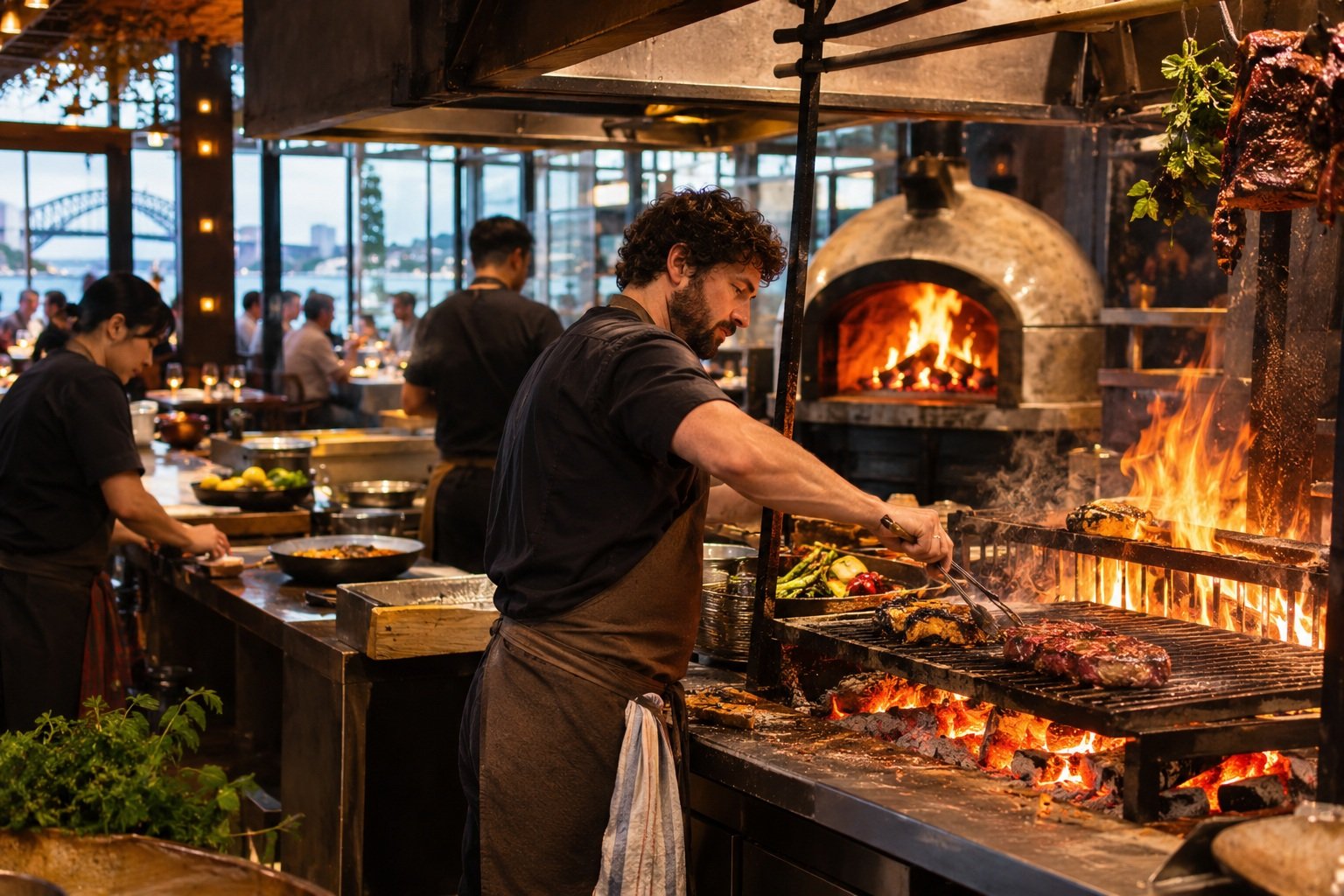
For years, Australia‘s live-fire narrative centred on a handful of Sydney fine diners—Firedoor, the Grill Americano, and their imitators. The 2026 reality is far more dispersed. Wood-fired cooking has migrated into suburban steakhouses, rooftop bars, and immigrant-owned kitchens that are using fire not as a gimmick but as a cultural inheritance.
Consider Wildflame Barbeque and Bar in East Maitland, a brick-and-timber room where mesquite-smoked meats and dry-aged cuts anchor a menu designed for lingering rather than Instagram. Or Kost in Broadbeach, where an open-fire grill fuelled by charcoal and ironbark wood sits at the centre of a coastal bar and grill serving “fire-kissed foods” to beachside crowds. These are not temples of gastronomy; they are neighbourhood restaurants where fire is simply how dinner gets made.
Agnii and the Cultural Argument for Fire
The most significant opening of 2026 may be Agnii in Windsor, Melbourne. Chef Gayan Pieris built the restaurant around a dara lipa—an open clay hearth found in Sri Lankan home kitchens—and a poranuwa, an enclosed hearth used for smoking fish and drying ingredients. As Pieris explained to The Age, the hearth is “my replication of my mum‘s kitchen,” and the restaurant’s name means “fire” in Sanskrit.
What makes Agnii important is not novelty but authenticity. Pieris is not importing a European technique; he is scaling a domestic South Asian practice into a commercial context. The poranuwa also produces umbalakada—smoke-dried tuna comparable to Japanese katsuobushi—used to build umami depth in sambals and curries. This is fire cooking as cultural preservation, not trend-chasing.
The Suburban Steakhouse Equation
At the more accessible end, venues like Red Gum BBQ on the Mornington Peninsula and Smokey Mary BBQ on Sydney‘s Northern Beaches demonstrate that wood-fired cooking can work at $40–50 per head. Red Gum’s 12-hour smoked pork shoulder with Carolina-style sauce, served in a room built around communal tables, offers the sensory pleasure of live fire without the fine-dining price tag. Smokey Mary‘s 12-hour brisket, meanwhile, has filled a gap on the Northern Beaches that locals apparently felt keenly.
The common denominator across these venues is not technique or price point but conviction. Whether it’s a Sri Lankan hearth in Windsor or a Texas-style pit in Narraweena, the fire is tended with purpose. As Urban List Sydney noted in its 2026 survey of charcoal cooking, “fire-led cooking is moving beyond takeaway staples and into some of the city‘s most exciting kitchens—where flame has graduated to both the method and the menu hero”.