A Market Growing Faster Than Supply
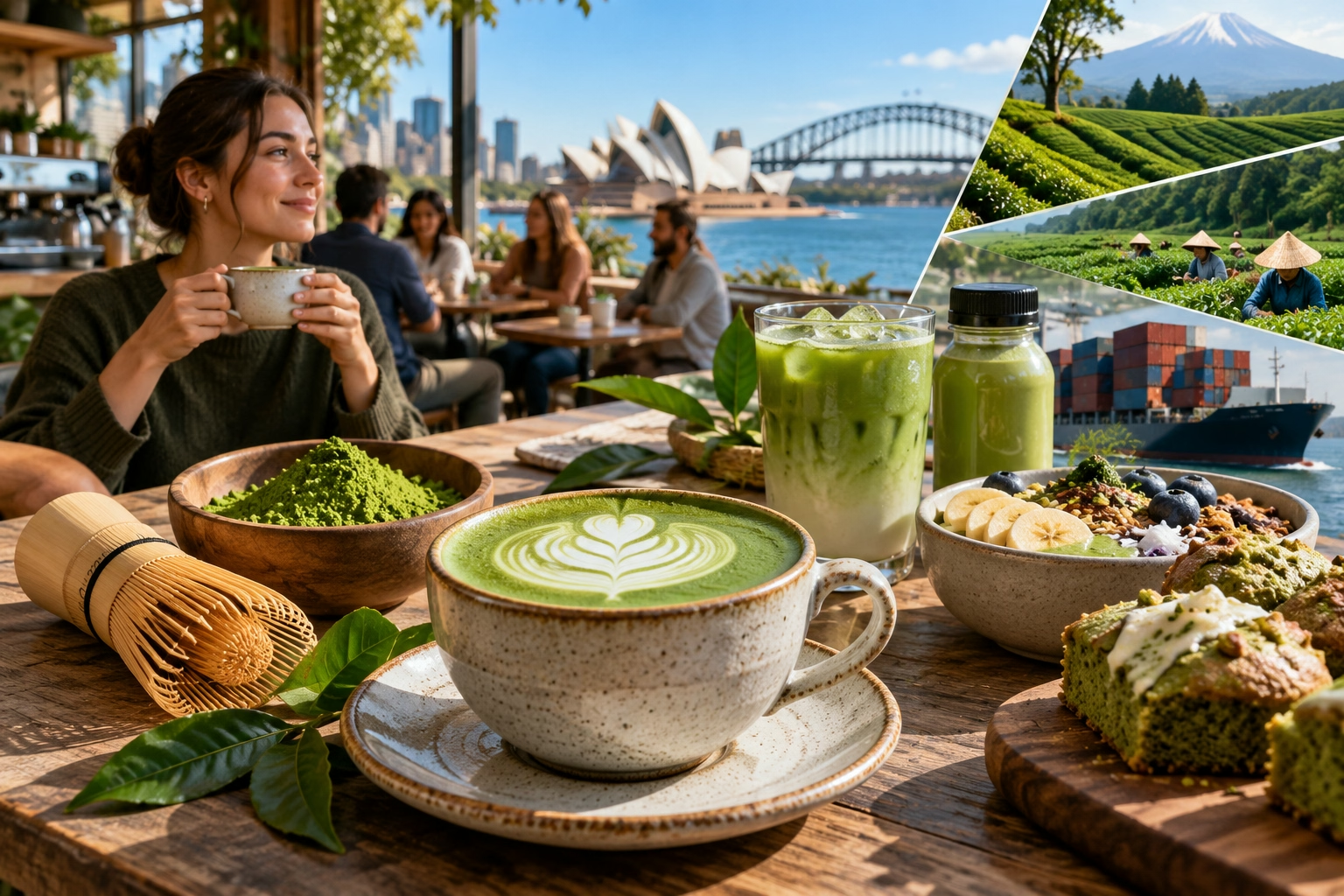
Australia’s matcha market is projected to expand at a 10–14% compound annual growth rate between 2026 and 2035, with total volume likely to more than double over the period. Household penetration is expected to climb from below 12% toward 25–30%, driven by deepening demand across café, foodservice, and retail channels. The numbers are striking for a country with a modest population, but they reflect a broader shift in Australian consumption habits: matcha has moved from a niche health ingredient to a mainstream category with its own supply-chain dynamics.
The Import Surge and Its Limits
Australia is now the eighth-largest export destination for Japanese green tea globally. Between January and August 2025 alone, imports from Japan reached 195,319 kilograms, a 131% year-on-year increase, according to the Japanese Tea Export Promotion Council. That import intensity has a downside. The wholesale price of tencha—the shade-grown leaf that becomes matcha—has risen 69% in a year, from a 2025 high of 8,235 yen per kilogram to an average of 13,972 yen. Australian cafés and brands are absorbing costs that would have been unthinkable in the flat-white era.
Where Growth Is Actually Happening
The IndexBox report identifies three structural drivers: household penetration, menu innovation in foodservice, and the acceleration of ready-to-drink matcha beverages in convenience and grocery formats. The culinary and commodity segments are expected to deliver the largest volume gains, while premium and ultra-premium tiers grow more slowly at 8–10% CAGR but maintain value share as consumers trade up. Private-label penetration could rise to 15–20% of retail volume by 2035, particularly if procurement and packaging efficiencies narrow the price gap between own-brand and specialty matcha.
The Functional Wellness Frontier
One of the clearest opportunities lies in functional wellness. Matcha blended with collagen, mushroom extracts, or nootropics is gaining traction in both retail and direct-to-consumer channels. Australian consumers show a high willingness to pay for health products, and matcha’s association with antioxidants, L-theanine, and clean-label ingredients aligns with preferences expected to persist for the next decade. Brands that combine clean-label positioning with credible efficacy claims—stress reduction, cognitive focus—stand to capture a disproportionate share of the premium segment.
Supply-Chain Diversification as Strategy
The reliance on Japanese supply is both a quality benchmark and a vulnerability. Risks to the forecast include supply constraints in Japan, potential trade disruptions, and competition from other functional beverages. Forward-looking Australian brands are beginning to invest in high-quality Chinese and Southeast Asian matcha production, coupled with rigorous certification and transparent sourcing, to capture the mid-market and foodservice segments with lower costs and more reliable supply. Australia’s low tariff environment and stable import infrastructure make it a favorable destination for these strategic sourcing models. The market is no longer simply about access to Japanese powder—it is about building a resilient, multi-origin category that can sustain double-digit growth without being hostage to a single harvest.