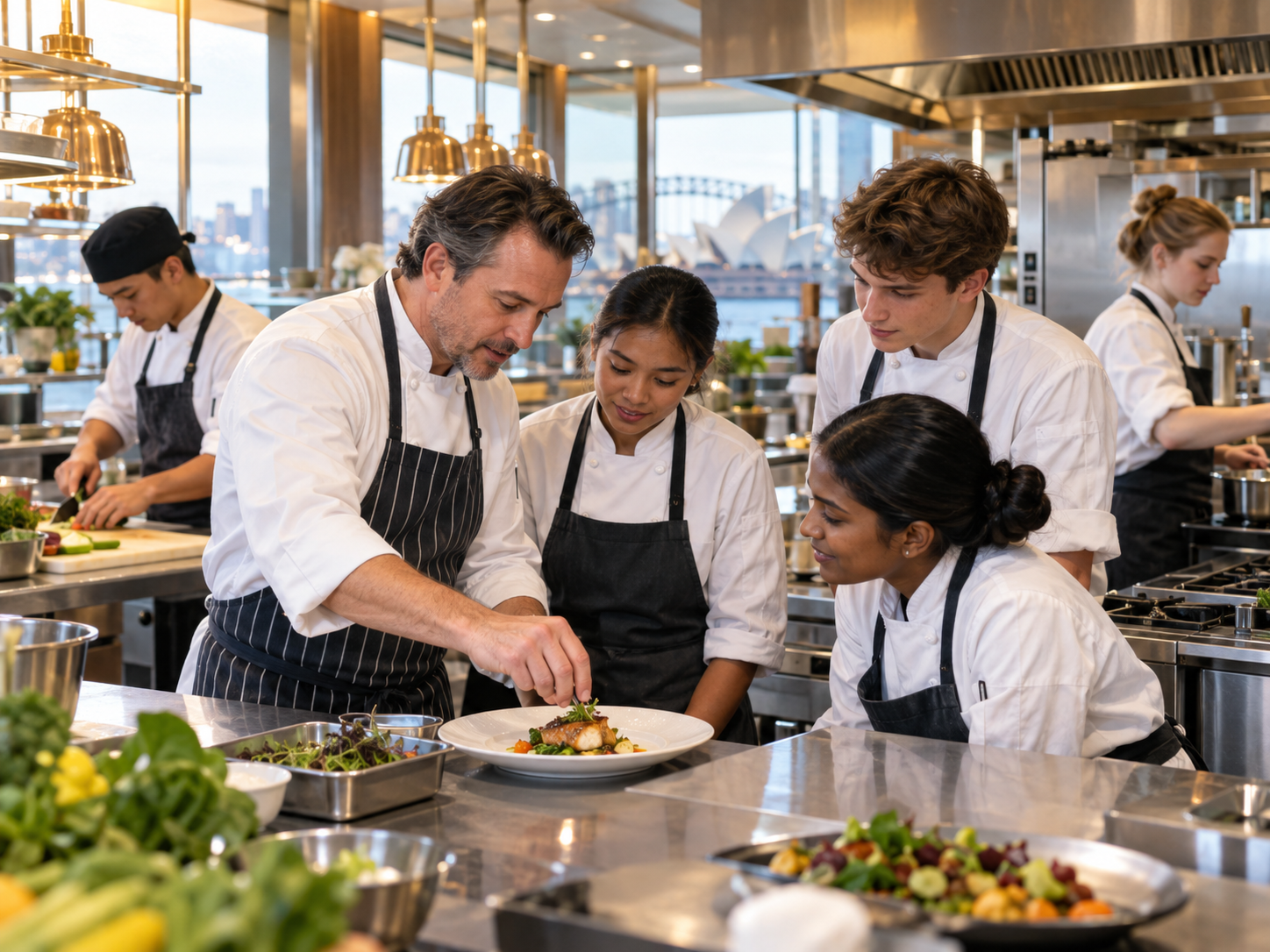
In June 2026, William Angliss Institute unveiled a $6.5 million upgrade to its Melbourne CBD training facilities, creating “super kitchens” that accommodate up to 48 students across three simultaneous classes. The investment—$4 million from the Victorian Government and $2.5 million from the Institute—brings the total number of teaching kitchens to 14 and introduces industry-standard equipment including induction and gas cooking stations, meat ageing machines, food smokers, and environmentally sustainable e-water systems.
The Philosophy of Industry-Standard Facilities
The logic behind this investment extends beyond aesthetics. When students train on equipment they will encounter in professional kitchens, the transition from classroom to commercial environment becomes significantly less jarring. Sebastian Sossa, a dual Certificate III in Commercial Cookery and Certificate IV in Patisserie student working as a Commis Chef at Stokehouse St Kilda, noted that the new equipment improves precision and efficiency: “You can focus on doing things properly and getting more accurate outcomes”. China Esson, a Certificate II student at Pan Pacific Melbourne, highlighted the value of learning on both induction and gas systems: “It gives you the confidence to step straight into a professional kitchen”.
Free TAFE and the Accessibility Question
The infrastructure upgrade is complemented by Victoria’s Free TAFE program, which offers tuition-free study in Certificate III in Commercial Cookery, Certificate IV in Kitchen Management, and Certificate II in Baking. This policy combination—world-class facilities and zero tuition costs for eligible students—positions Victoria as a national leader in culinary education accessibility. The state’s hospitality sector comprises more than 30,000 venues, and the pipeline of skilled workers emerging from Angliss feeds directly into that ecosystem.
Real-World Confidence and the Employer Connection
The most compelling argument for this investment is the feedback from students who are simultaneously employed in the industry. The alignment between training and practice is not theoretical—it is experiential. Students who work in professional kitchens during their studies bring questions, observations, and refinements back to the classroom, enriching the learning environment for their peers. Grant Dreher, CEO of William Angliss Institute, framed the investment as a commitment to “putting our students on pathways to exciting careers” and ensuring they develop “the practical, industry-relevant skills needed now and into the future”.
The Scalability Challenge
The super kitchens represent a significant capacity expansion, but the question of whether infrastructure alone can solve the chef shortage remains open. Facilities can attract students; they cannot guarantee retention. The 900-hour placement requirement embedded in many vocational programs demands that industry partners absorb trainees at scale, and the recent halving of federal apprenticeship incentives may constrain that capacity. Nevertheless, William Angliss’s 2026 investments signal that at least one major institution is betting heavily on the future of Australian culinary talent.